The Astros finalized his three-year, $54MM contract Tatsuya Imai in the afternoon. It was surprising that the Japanese righty ended up in Houston – not because the Astros didn’t need a starter, but because of what appeared to be a tight budget.
Imai received an estimated annual valuation of $18MM which came in below most estimates. Houston received a short-term contract with a reasonable salary by offering opt-outs after each of the first seasons. RosterResource projects their Opening Day earnings to be around $242MM. They have an estimated $238MM in luxury tax liabilities. The Astros also need to pay a $9.975MM release fee to Imai’s NPB club, the Seibu Lions. That does it not to count against their luxurious tax ledger, although it is an insignificant sum of one year of Imai’s services when he comes out.
The Astros opened the 2025 season with a salary cap of $220MM. Their end-of-season luxury tax number came in at just $246MM, which earned them a small fee ($1.5MM) for exceeding the base cap of $241MM. The cap for next season is $244MM. They are already about $6MM of that number. A team’s luxury tax payment is not completed until the end of the year, meaning mid-season acquisitions are calculated separately from that amount. As well as any compensation and open contracts for players on minor league deals selected from the MLB roster.
A preseason report indicated that Houston owner Jim Crane was reluctant to cross the tax line for what would have been the third straight season. Chandler Rome of The Athletic wrote this morning that even Imai is still on the books.
Will that be a strong mandate? Crane did not want to pay CBT for the last two seasons. That quickly changed in 2024, when they responded to season-ending injuries Kendall Graveman by signing Josh Hader – the agreement that brought them into the tax haven. Houston stayed below the CBT line entering the ’25 season. Then came the chance to recover Carlos Correa deadline, and push them further. The owner has changed his mind before.
As it stands, it’s hard to see the Astros staying below the tax line through the 2026 season. They will be very limited in what they can accomplish during the trading deadline. RosterResource’s calculations are informal and pending resolution in many arbitration cases, so there are decent-sized margins of error in the $238MM estimate, but the broad point remains that they’re not too far below the CBT line. Some clubs prefer to have more than $10MM in payroll to extend the season.
That could lead to the front office shelling out a few million in offseason trades. Let’s take a look at how their payroll is growing.
Players on Guaranteed Contracts (10)
Correa, Altuve and Alvarez are apparently not for sale. Hader solidifies the bullpen and heads into the third season of a five-year contract; he is not going anywhere. Imai, Weiss and Pearson signed free agent contracts this offseason. That leaves only three opportunities for this team.
Javier is headed to the fourth season of a five-year, $64MM extension. His deal comes with a $12.8MM luxury tax. Tommy John surgery ended most of his last two seasons. He played eight games at the end of last year. His strikeout rate was lower compared to pre-surgery levels but the raw materials didn’t look much different. It’s fair to say that his inconsistency stems from layoff rust. A swing team might consider selling low in this situation, but that’s not a luxury the Astros can afford. They will need to replace him in the middle of the rotation and are unlikely to find anyone better in free agency for less than $13MM per year.
McCullers is making $17MM in the final season of his five-year extension. An injury cost him all of 2023-24. He pitched to a 6.51 ERA over three IL starts last year. He might look at minor league offers if he were a free agent. No one takes any of these contacts unless the Astros attach a chance to convince the team to pay a small percentage. Maybe that will work for a rebuilding club, but McCullers also forfeited draft rights when he crossed the 10-year service limit last season. There is probably not much to be done about this.
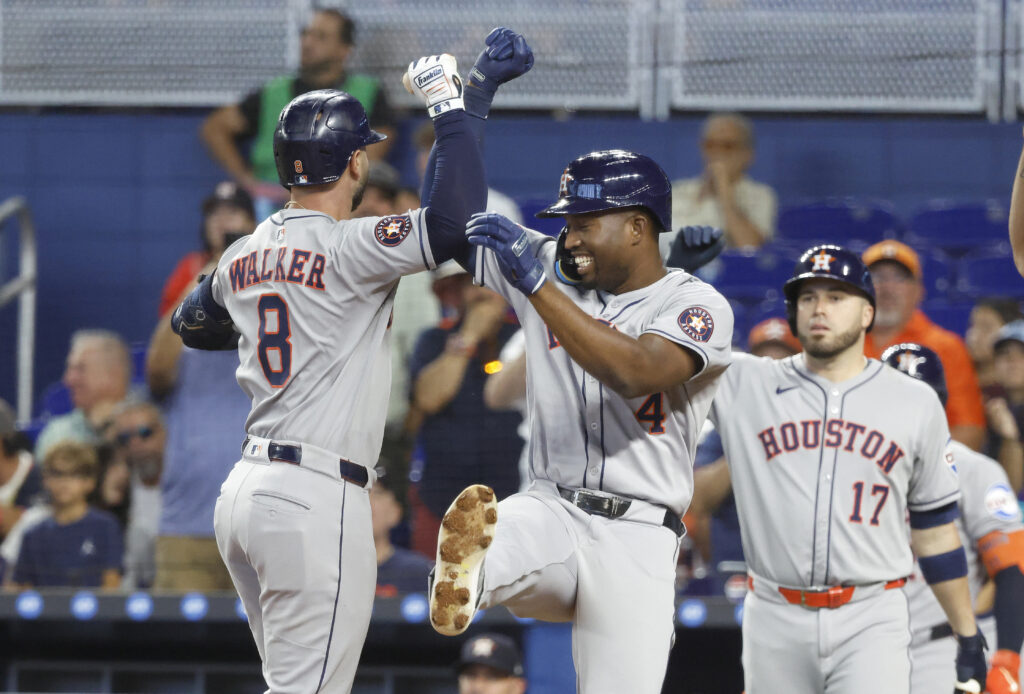
Of the players on guaranteed deals, that leaves only Walker. He is owed $40MM over the next two seasons and accounts for $20MM in the tax book. His first year in Houston was a disappointment. Despite hitting 27 homers, he had a below average .238/.297/.421 batting line over 640 plate appearances. Walker’s excellent defensive metrics are solidified. He picked things up offensively with a near-.800 OPS in the second half, though even that tally was eclipsed by a .277 on-base percentage in September.
Overall, Baseball Reference rated Walker as a replacement player. FanGraphs credited him with one win. He wouldn’t be close to $40MM in his age 35-36 season if he was a free agent. Even finding another team to cover half of the contract would be a challenge. (Ryan O’Hearntwo years younger, he just signed a two-year deal at $14.5MM annually coming off a .281/.366/.437 season that averaged 2-3 WAR.) The Astros could probably find a taker if they paid Walker down to $7-8MM per season, though that would be a lot of dead money to eat up a third contract. General manager Dana Brown played down the possibility of moving Walker at the GM Meetings in early November, calling him the team’s “everyday first baseman.”
Players Eligible for Arbitration (12)
- Another De Los Santos, Bryan Abreu, Steven Okert, Isaac Paredes, Jesus Sánchez, Jeremy Peña, Jake Meyers, Hunter Brown, Yainer Diaz, Nick Allen, Bennett Sousa, Hayden Wesneski
There is no chance of a Hunter Brown trade. Dana Brown said at the Winter Meetings that teams weren’t even asking about Peña because they knew there was “no way” they were going to clear their franchise stopper (with Rome).
De Los Santos will make $1.6MM after avoiding arbitration. The Astros wouldn’t tender him if they wanted that little money on the books. Okert, Allen, Sousa and Wesneski are all listed by MLBTR contributor Matt Swartz with salaries of $2MM or less. The savings compared to the $780K minimum would not be insignificant. They are useful role players or, in Wesneski’s case, a potentially valuable long-term piece.
Abreu ($5.9MM average) and Diaz ($4.5MM average) are probably too valuable to trade. The former is their best setter, the latter their first draftsman. While there may be a lot of interest in both, they are not easily replaced by someone who makes the league smaller. That leaves three players: Paredes, Meyers and Sánchez.
Paredes is expected to earn $9.3MM and has two years of control remaining. The GM said in November that the team had “no interest” in moving him. Paredes had the best start to his Astros tenure, hitting 20 homers with a .254/.352/.458 line over 438 plate appearances. He missed most of the second half with a significant hamstring injury. The Astros responded by acquiring Correa to play third base. Paredes could slot in at second base but is unlikely to be a solid defender there. Walker is penciled in at first for now with Alvarez and Altuve splitting left field and designated hitter.
The Astros dangled Meyers for a controllable starter early in the offseason. It would have been a sold situation on the heels of a career-best .292/.354/.373 showing at the plate. He’s unlikely to move as the Astros deal with an outside prospect Jacob Melton to Tampa Bay in a three-way trade for the No. 1 spot Mike Burrows. Meyers’ $3.5MM projection isn’t alarming, and trading him would put a lot of faith in the rookie Zach Cole stepping up as an everyday center fielder.
That could leave Sánchez as their top salary-dump candidate. He is expected to earn a $6.5MM salary, and it was surprising that Houston offered him a contract at all. Sánchez was a disappointment after the deadline deal from Miami, hitting .199 / .269 / .342 over 160 plate appearances while making several defensive stops. They can buy Sánchez and add a cheap left-handed free agent (eg Mike Tauchman, Michael Conforto) to compete with Cole and Cam Smith right field playing time.