The amazing story of Michael Zheng: An Ivy League student competing in the Australian Open | ATP Tour

Everything Adds Up
The amazing story of Michael Zheng: An Ivy League student competing in the Australian Open
How the Columbia University star balances a heavy academic load with playing elite tennis
January 17, 2026
ATP
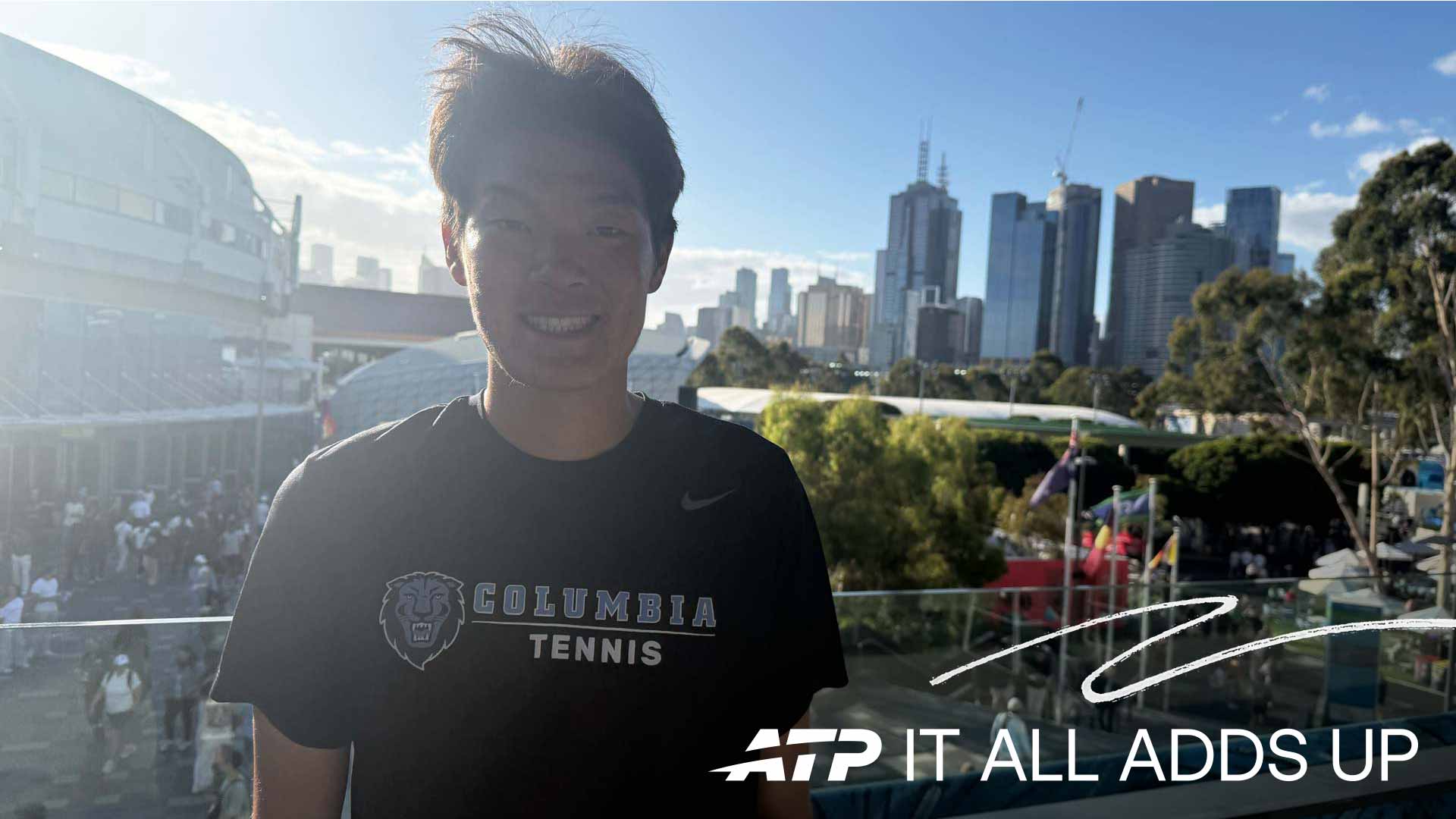
Michael Zheng competes in his first major draw at the Australian Open.
Written by Andrew Eichenholz
Michael Zheng will take five courses this spring semester at Columbia University in New York, where he is a senior. This 21-year-old student will soon graduate from an Ivy League institution, one of the most prestigious schools in the world.
But even though school starts on January 20, that won’t be the focus this week. Instead, the student athlete is on the other side of the world competing in a major tournament for the first time at the Australian Open.
“Right now, I’m very happy,” Zheng, a qualified player, told ATPTour.com. “And I’m relieved to get past that and get a chance to play my first major draw.”
Last year, that was more than impossible. Zheng was the reigning NCAA men’s singles champion, but still outside the Top 700 in the PIF ATP Rankings. However, he balanced it with a solid education – earning Academic All-American honors and the Rafael Osuna National Sportsmanship Award in 2025 – and college tennis proving he can compete with the best players in the world.
Zheng has been showing talent for a long time, ever since his father, Joe, decided to introduce Michael and his two-year-old sister, Amy, to a play at their local high school. Joe, who immigrated to the United States from China, loved the sport when he first arrived and passed it on to his children.
Growing up in New Jersey, Zheng spends three days a week during middle school training at the USTA Billie Jean King National Tennis Center, home of the US Open. And at the end of his young career, the American reached the 2022 Wimbledon boys’ singles final, defeating Coleman Wong and Martin Landaluce along the way.
“I had talent, so he wanted to see how far he could take it,” Zheng said of his father. “And now here we are playing my first important game [of a major]. It was quite a competition.”
But it was atypical. Zheng is a diligent college student who must in the coming days prepare for a psychology course in New York winter. Instead, he warms up in the Australian summer. The humble student doesn’t make a big deal out of it, but Ivy League courses are tough in themselves.
“Academic rigor has helped Michael in many ways, especially mentally,” said Howard Endelman, Columbia’s head men’s tennis coach. “The school work goes hand in hand; it allows Michael to focus and develop aspects of his life outside of tennis. Although it may be counterintuitive, this combination has helped Michael become a well-rounded person that has really helped his tennis.”
According to Zheng, Endelman consistently reinforces this message.
“You learn to manage your time and times of stress, I think you can manage better, because you put in all that work at the same time, you balance school,” Zheng said. “I think it gives you that little bit that you think, that you do maybe a little bit more than these other people, and at the same time, your quality is there.”

What made his standout moment on Sunday against Sebastian Korda at Melbourne Park so impressive was how he got there. Not only did he have a tie for the qualifiers, but he made a great run to earn his place in the first place qualifier.
In early June, Zheng was outside the world’s Top 700. But the run to the ATP Challenger final in Little Rock began with a bang, with titles in Chicago, Columbus and Tiburon proving it was no fluke.
“Shortly after winning the Tiburon Challenger finals in October, Michael took a Sunday night flight to the red so he could check it out for himself Monday morning in New York City,” said Endelman. “You’re just taking it slow.”
The final two tournament victories came when Zheng took five classes, before successfully defending her NCAA singles crown.
“It’s definitely not easy. At the same time, I think people tend to overestimate the course. I think you can make it as difficult or as easy as you want,” said Zheng, a major in Psychology. “I’m leaving, I missed a little class, so I won’t be doing anything too crazy, like neuroscience, biology or something like that. But at the same time, you can sign up for whatever classes you want to take.”
Entering college, Zheng did not plan to study psychology, but economics. The 21-year-old found it interesting, even if he doesn’t believe there is a strong connection between his studies and psychology on the tennis court.
Zheng’s memorable run almost came to an end in the final qualifying round against Lukas Klein, who faced him with a match point at a break in the final set. But the Columbia Lion handled that pressure the way he did in school: successfully.
“Nothing seems to bother Michael – on or off the court – especially when things aren’t going well,” Endelman said. “Michael lost the lead after getting up 7/1 and 9/7 in the final set breaker, and then suddenly dropped 9/10. Without emotion, he calmly goes up to the line and saves the match point with a wide ace.”
Although Zheng’s tennis career is still in its infancy, the future is bright both on and off the court with a college star. But the World No. 174 isn’t too worried about what will come with her Psychology degree just yet.
“I’m not thinking too long right now,” Zheng said. “I’m focused on seeing how far I can take tennis and focusing on that at least 100 percent.”