As part of their offseason overhaul, the Mets have delivered Bo Bichette again Jorge Polanco to develop their field. Polanco received a two-year, $40MM deal in December. Bichette, one of the top free agents, signed a three-year, $126MM deal in January with an opt-out after 2026 and 2027. At worst, Bichette and Polanco will be playing new positions. The former will be the hot corner, while Polanco will split time between first base and DH.
Between the two, Bichette is the superior offensive talent. Excluding an injury-plagued 2024 season in which he played in just 81 games, Bichette has had at least a 20% better wRC+ average in every campaign since 2019. Last year, he tied for the 25th lowest strikeout rate (14.5%) among 145 professional hitters in the league. His overall line of .314/.357/.483 was good for a 134 wRC+, the best full-season mark of his career.
Polanco is coming off his career season. In 524 plate appearances with the Mariners, he hit .265/.326/.495 with a 132 wRC+ that almost matched Bichette’s performance. Polanco also cut his strikeout rate in half, from 29.2% in 2024 to 15.6% in 2025. His record before 2025 was strong, if a step below Bichette. From 2019-24, Polanco can generally be counted on as a 15-25% better offense than average, with 2020 (82 wRC+) and 2024 (93 wRC+) being the exceptions.
None of them are strong defenders. Bichette played only shortstop in the regular season, moving to second base in the 2025 World Series (again because he was injured). His list dropped out of the first percentile in 2025, while Statcast took negative views on his arm strength and running speed. In total, his glovework valued at -12 Defensive Runs Saved and -13 Outs Above Average, the latter a career-worst mark. It looked like he was going to move to a different position for a long time, and now the Mets are going to put him at the hot corner. On the one hand, that makes sense given the acquisition of a defensive hero Marcus Semien to man the keystone. However, it is doubtful that Bichette will often struggle on right-handed balls, which he will see a lot at third base.
Meanwhile, Polanco began his career as a shortstop but has played second and third base since early 2023. In 2024, he was eligible for -1 DRS and -10 OAA as a full-time second baseman. In 2025, he compiled -4 DRS and -4 OAA between second and third base, although he played only 330 1/3 innings of defense, with the Mariners sending him as the DH in 88 of 138 games. Like Bichette, Polanco is underrated by Statcast for his range and arm strength, though this won’t matter as much at the cold corner. Furthermore, while Bichette struggles with balls from right-handed hitters, the opposite is true for Polanco. Starting in 2024-25, he was worth -2 OAA on balls played to the right, compared to -12 OAA on balls played from the left. Just as Bichette will be more exposed to right-handed contact at third base, Polanco will be exposed to left-handed contact at the cold corner.
The question of which player is the best value for the Mets may come down to finances. While the Mets are in a good position to take on expensive contracts, the current front office under president of baseball operations David Stearns shows a clear preference for short-term deals. Bichette can opt out after 2026, so there’s a chance his deal will change to a one-year, $47MM deal ($42MM AAV plus a $5MM exit bonus). On the one hand, that gives the team long-term flexibility, but it might be too much for someone who’s already not a solid linebacker and is now learning a new position.
Polanco’s deal does not contain an opt-out, so the Mets are on the hook for $40MM in guaranteed money through 2027. He costs half as much as Bichette, but his offense is more dangerous given that he ran a worse-than-average strikeout rate as recently as 2024. If Polanco has to move up in that area, his foundation is intact. His walk rate has declined every year since 2022, while Bichette’s has remained the same (albeit below average). In addition, Polanco is four years older than Bichette and is more likely to decline as he plays in his 30s.
What do MLBTR readers think? Does Bichette’s offense justify his high AAV, even defensive questions at third base? Will Polanco repeat last year and use a less desirable position? Which one offers better value for their current salary? Let us know in the survey.
Is Bo Bichette or Jorge Polanco the better value for the Mets?
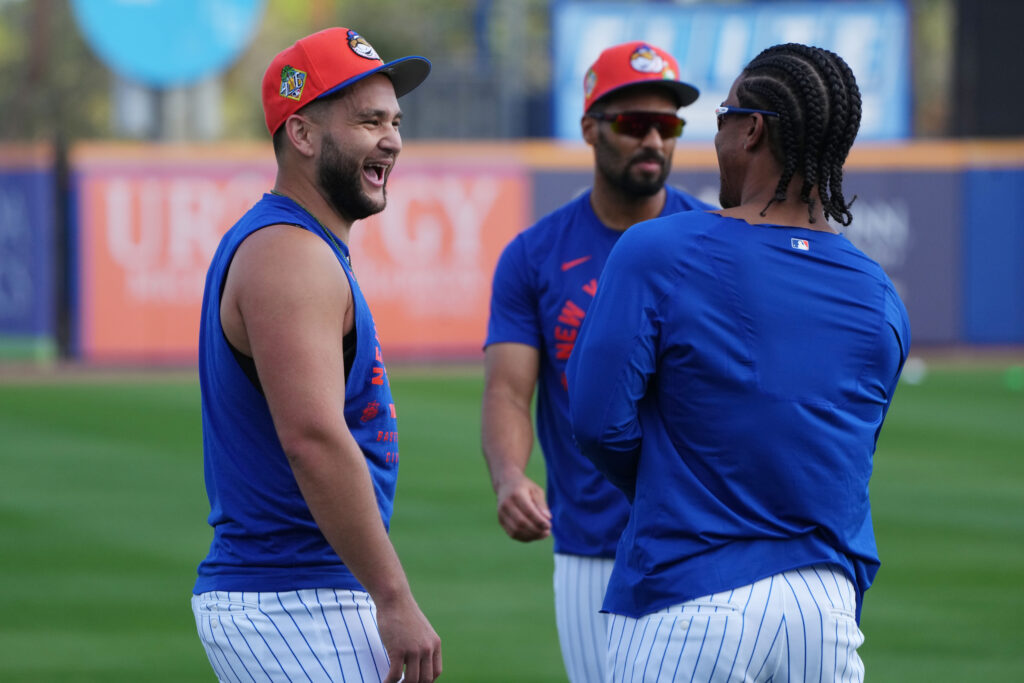
Photo courtesy of Jim Rassol, Imagn Images