Patrick WilliamsTheAHL.com Features Writer
Long before he won three Stanley Cups, played 939 regular season games, captured an Olympic gold medal, graced the cover of Chicago magazine, or went into broadcasting, Patrick Sharp he knew the American Hockey League.
Now after more than 20 years, Sharp is learning the AHL again in a different place.
Selected in the third round of the 2001 NHL Draft by the Philadelphia Flyers, Sharp played two seasons at the University of Vermont before joining the AHL’s Philadelphia Phantoms in the fall of 2002.
He was only 20 years old, and it showed. His rookie season was solid enough, scoring 14 goals with the Phantoms and getting into three NHL games with the Flyers. But a long and successful career was not a sure bet.
In that second season, however, Sharp began to look like he could have a solid NHL future. He tallied 15 goals and 29 points in just 35 games with the Phantoms, played 41 regular-season games for the parent team, and skated in 12 more postseason contests — mostly getting limited fourth-line minutes — as the Flyers reached the conference finals.
The 2004-05 NHL lockout may have been the best thing for Sharp.
Back with the Phantoms, Sharp became a prolific contributor, scoring 52 points in 75 games and being selected to the AHL All-Star Classic. And when the Calder Cup Playoffs came around, he played a leading role. It was a time of change for the entire Philadelphia organization, with a first round pick Jeff Carter again Mike Richards joining an AHL club in time to join Sharp in dominating the postseason. In the Game 4 final against the Chicago Wolves on June 10, 2005, Sharp scored two goals, added an assist and hoisted the Calder Cup in front of a crowd of 20,103 fans at what is now the Xfinity Mobile Arena in South Philly.
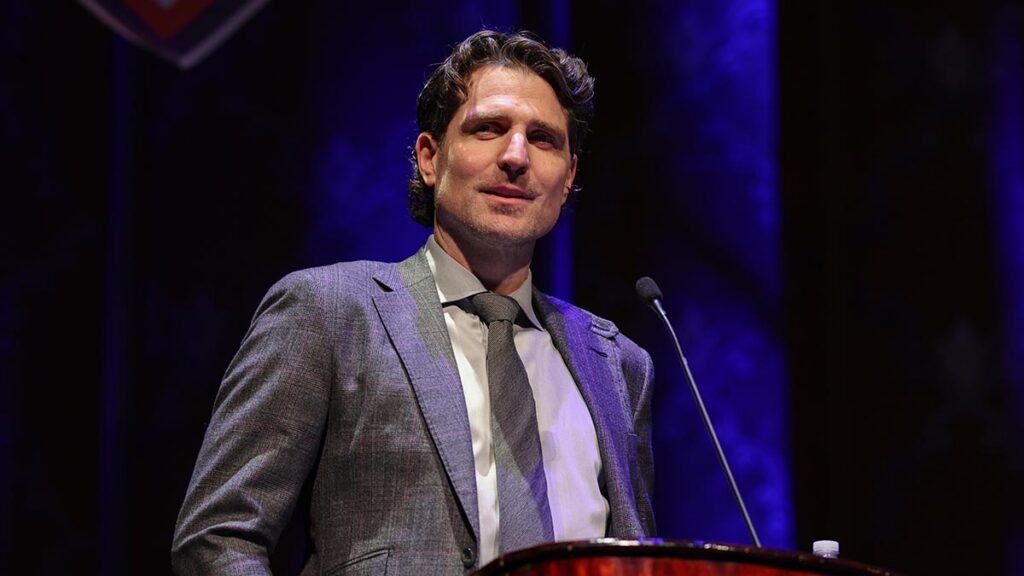
Speaking in Rockford, where he was named an honorary captain for the 2026 AHL All-Star Classic this month, Sharp called the Phantoms’ championship “a big part of my development.”
In December 2005, Sharp was a key piece in a trade that helped rebuild the Chicago Blackhawks. He would go on to win Stanley Cups in 2010, 2013 and 2015, earn MVP honors in the 2011 NHL All-Star Game, and capture a gold medal with Canada at the 2014 Sochi Olympics.
Now, all these years later, Sharp’s career with the Flyers organization has begun again. He completed his playing career in 2018 and spent two seasons at his alma mater before returning to the Flyers in 2023 as a special advisor for hockey operations. Part of that job description involves getting on the ice and showing today’s Flyers hopefuls at Lehigh Valley or ECHL Reading how it’s done.
“I love it,” Sharp said. “I love being around the players. I learn a lot from the coaching staff, the Flyers and the Phantoms, and I really enjoy being on the ice with the kids in track suits. I still wish I was wearing my clothes.”
After a fast start to the season, Lehigh Valley lost 11 of 13 games before sweeping Hershey in two games this past weekend. With 50 points, they are trying to climb the Atlantic Division standings while keeping their pursuers far enough away. One night, it seemed like most of the Phantoms were ready for the NHL. One night, their ignorance shows.
So go to the expected development. It was a lesson Sharp had to learn more than two decades ago, and it’s a message that as a 44-year-old he’s trying to convey to the youth of Philadelphia’s organization today.
“Not all players get drafted and go straight to the NHL,” Sharp said. “Most guys need some time to develop and take those steps professionally on and off the ice. For me, leaving the University of Vermont as some lazy college kid, I learned how to take care of myself off the ice, be professional every day. I learned how to find that competitiveness in me.”
Sharp’s head coach as a prospect in Philadelphia was an AHL Hall of Famer John Stevens20 years behind the NHL bench after long playing and coaching stints in the AHL. It was Stevens, Sharp said, who introduced some of the lessons — and tough love — that a young person like him needed.
“He was hard on me,” Sharp said. “He put in a lot of time to develop me. I think he saw something in my game that he could bring out, and I’m grateful. (There were) a lot of tough conversations and tough days in the rink, but at the end of the day my last game in the American League I was lifting the Calder trophy over my head because of the many things that John Stevens taught me and taught our team.”
Today’s Phantoms are trying to learn those same lessons. Part of Sharp’s role today reflects the important improvements and tools NHL organizations are putting into their AHL affiliates now. Players today are able to get individualized instruction and guidance on a specific aspect of the game from someone like Sharp to complement the entire coaching staff.
“‘Perseverance’ would be the key word,” Sharp said of his message to those prospects. “Belief is believing in yourself and your abilities that everything will come true. Be ready for your opportunities… You never know when they will come.
“That’s what we tell our guys at Lehigh all the time. You can say they have one foot out the door ready to get to that NHL level, but I’ve seen players come up and not be ready for that. So my job with the player development staff is to prepare our guys as best as I can to be ready for that next step.
“But belief is the biggest thing, believe in yourself, believe in all the hard work you do that you will have a reward one day.”

In the American Hockey League for two decades, TheAHL.com features writer Patrick Williams and currently covers the league for NHL.com and FloSports and is a regular contributor to SiriusXM NHL Network Radio. He was the recipient of the AHL’s James H. Ellery Memorial Award for the league’s top scorer in 2016.